What 50+ Developers Taught Me About Teaching Code
After running 3 government-sponsored bootcamps and training 50+ developers, the patterns are clear — what trips people up, what accelerates learning, and why AI changed the classroom.
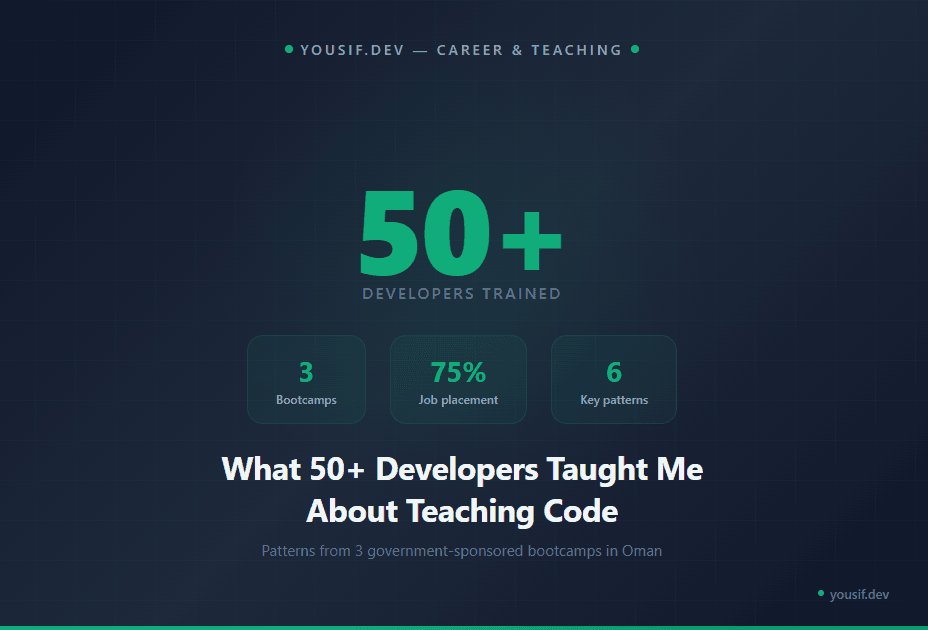
I've stood in front of 50+ developers across 3 government-sponsored bootcamps. Some arrived terrified of code. Some arrived overconfident. Both groups taught me something.
These bootcamps were part of the Makeen program in Oman, run in partnership with the Ministry of Transportation. The stakes were real — these developers were training for actual jobs, not hobby projects. And the 75% placement rate we achieved wasn't luck. It was patterns.
Here's what I learned from the people I was supposed to be teaching.
The Biggest Misconception Beginners Arrive With
Almost every new student walks in believing the same thing: programming is about memorizing syntax.
They arrive with notebooks. They write down every function signature. They highlight keywords. And for the first two weeks, the memorizers look like they're ahead.
Then week three hits. The problems get ambiguous. The instructions say "build a feature" instead of "copy this code." And the memorizers freeze — because there's nothing to memorize. The problem is new.
The best students weren't the ones who memorized fastest. They were the ones who asked "why" before "how." Why does this function return a promise? Why is state managed this way? Why would I choose PostgreSQL over MongoDB here?
The students who ask "why" in week one are the ones solving real problems by week eight.
The 3 Patterns That Predict Who Succeeds
After three cohorts, I can usually tell by week two who's going to make it. Not because of talent — because of behavior.
They Build Before They Feel Ready
The developers who started side projects in week two — messy, broken, incomplete side projects — consistently outperformed those who "studied more" and waited until week six. Building something forces you to confront what you don't know. Studying lets you avoid it.
They Debug Out Loud
The strongest problem-solvers talked through their bugs. Literally out loud. "Okay, the data comes from the API, gets stored in state, renders in the component... but the component re-renders when — wait, the dependency array is wrong." Talking through the problem reveals the mental model gap faster than staring at the screen.
They Actually Read Error Messages
This sounds absurdly obvious. It isn't. Most beginners see an error and immediately Google the whole thing, or panic, or call the instructor. The ones who succeed read the error first. Line number, error type, message. 80% of the time, the answer is literally in the error.
The error message is the first teacher. Most beginners skip it.
The 3 Patterns That Predict Who Struggles
Copy-Paste Without Understanding
It works until it doesn't. A student copies a working authentication flow from a tutorial. It works perfectly. Then the client needs a different role system. The student stares at code they can't modify because they never understood what it did — they just knew it worked.
Tutorial Addiction
I've watched students complete 10 tutorials and still feel "not ready" to build something. Tutorials give you the illusion of progress. You're following someone else's thinking, not developing your own. The gap between completing a tutorial and building something from scratch is enormous — and the only way to cross it is to start building.
Skipping Fundamentals for Frameworks
"I want to learn React" is the most common request. But when I ask "do you understand how JavaScript handles asynchronous code?" — silence. Frameworks are abstractions over fundamentals. If you don't understand what's being abstracted, you can't debug it, extend it, or reason about it when things break.
Frameworks change every two years. Fundamentals haven't changed in twenty.
How AI Changed My Classroom
When AI coding tools became accessible, the classroom dynamic shifted overnight.
The senior developers — the ones with strong fundamentals and system thinking — became dramatically faster. They used AI as a multiplier. They knew what to ask for, could evaluate the output, and caught edge cases the model missed.
The beginners who skipped fundamentals became more dependent. They could generate code they couldn't explain. They shipped features they couldn't debug. The speed was real, but the understanding wasn't.
The new core skill in my classroom became: can you verify what the AI just gave you? Not "can you write code" — "can you evaluate code." That requires the same fundamentals we've always taught, just applied differently.
AI didn't replace the need for fundamentals. It made fundamentals the difference between using AI and being used by it.
The 75% Placement Rate — What Actually Made It Work
People ask about the placement rate like it was one magic trick. It wasn't. It was a system.
Project-based from week one. Not "learn theory for 6 weeks then build something." Every concept was taught through building. Authentication? Build a login system. Database design? Design the schema for your project. API development? Build the endpoints your frontend needs.
Real presentations to real people. Every bootcamp ended with demo day. Students presented their projects to industry professionals, hiring managers, and government stakeholders. The pressure was intentional — it's the closest simulation to a real job interview.
Employers hired based on portfolios, not certificates. The students who got jobs fastest weren't the ones with the best grades. They were the ones who could show a working project, explain the decisions they made, and talk about the problems they solved. The portfolio was the resume.
Nobody got hired because they passed a quiz. They got hired because they built something and could explain how it works.
What I Tell Every New Student on Day One
Before we write a single line of code, I say this:
"The goal of this bootcamp is not to teach you to code. Coding is a side effect. The goal is to teach you to think in systems. How things connect. Why they break. How to break a big problem into small, solvable pieces. If you leave here with that skill, you'll be able to learn any language, any framework, any tool — because you'll understand the patterns underneath."
Three cohorts later, I still believe every word of that.